
Emergency piping · urgent
Burst and Broken Pipe Repair in Upland, CA: Stopping the Water, Then Replacing the Section
A burst is a sudden failure in a line that is under pressure, which is why it does not wait and does not improve. The volume that comes through a split in a supply line in ten minutes is more than most households expect, and almost all of the damage happens before anyone arrives.
This page covers the failure and the repair: finding the shutoff, stopping the flow, working out what broke, and replacing it. The drying and restoration that follows a serious one has a page of its own.
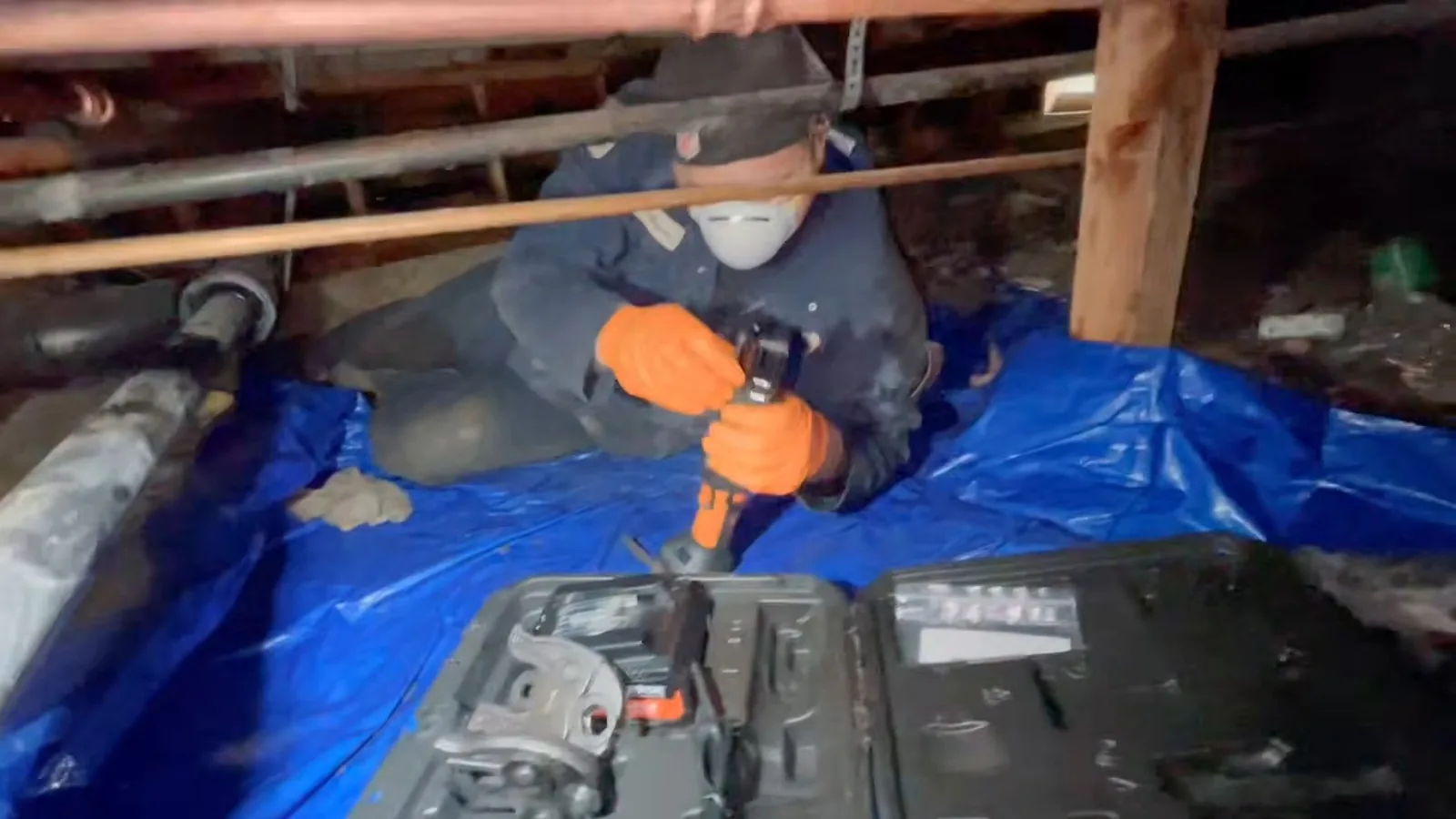
If water is moving right now, the order of the next few minutes matters more than who you call. Work down the steps below first, then call dispatch on (833) 571-0120 and keep the line open while you do it.
Shutting off the water and draining pressure from a burst pipe
- Shut the water. House valve first if you know where it is, meter box at the kerb if you do not. Turn it clockwise until it stops.
- Open the lowest tap in the house, inside and out. That drains the pressure out of the system downward instead of through the break.
- Deal with electricity before anything else, if water is anywhere near a fitting, an outlet or the panel. Kill the circuit from a dry position or leave the area.
- Shut the gas or power to the water heater if the failure is on the hot side and the tank is draining. A gas heater firing on an empty tank is a second problem.
- Move what can be moved and lift what cannot. Electronics, paper, rugs, the bottom shelf of anything. Foil or blocks under furniture legs stops stain transfer.
- Photograph everything before you mop. Wide shots and close ones, with the date on. That record is worth more later than the ten minutes it costs now.
- Call, and stay reachable. Dispatch will want to know where the water is coming from, whether it is stopped, and whether anyone has turned power off.
Water near a panel or an outlet comes before the plumbing
No pipe repair is urgent enough to be worth standing in water near live wiring. If the panel itself is wet, or you cannot reach it from somewhere dry, do not touch it. Keep people out of the room, call the utility, and tell dispatch that is the situation when you ring. Everything else can wait for that to be made safe.
Where supply lines actually break
In rough order of how often they turn up: a flexible washing machine or dishwasher hose that has aged and let go, a pinhole in copper, a failed solder joint, a screw or nail driven into a pipe during past work and only now corroded through, an outdoor tap line, an irrigation riser, and a buried service line between the meter and the house.
The appliance hoses deserve their own sentence because they are the easiest failure to prevent and the most destructive to suffer. They fail at full pressure with nobody home, they are usually behind a machine nobody moves, and they are the least costly item in this list to replace on a schedule.
A buried service line is the other end of the scale. It shows as a wet or unaccountably green patch of ground, a drop in pressure, or meter movement with the house valve shut, and locating it is its own job before any repair starts.
Pressurised failures compared: how each shows and what it needs
| Failure | How it shows | Typical repair |
|---|---|---|
| Appliance supply hose | Sudden volume at one appliance | New braided hose and an isolation valve |
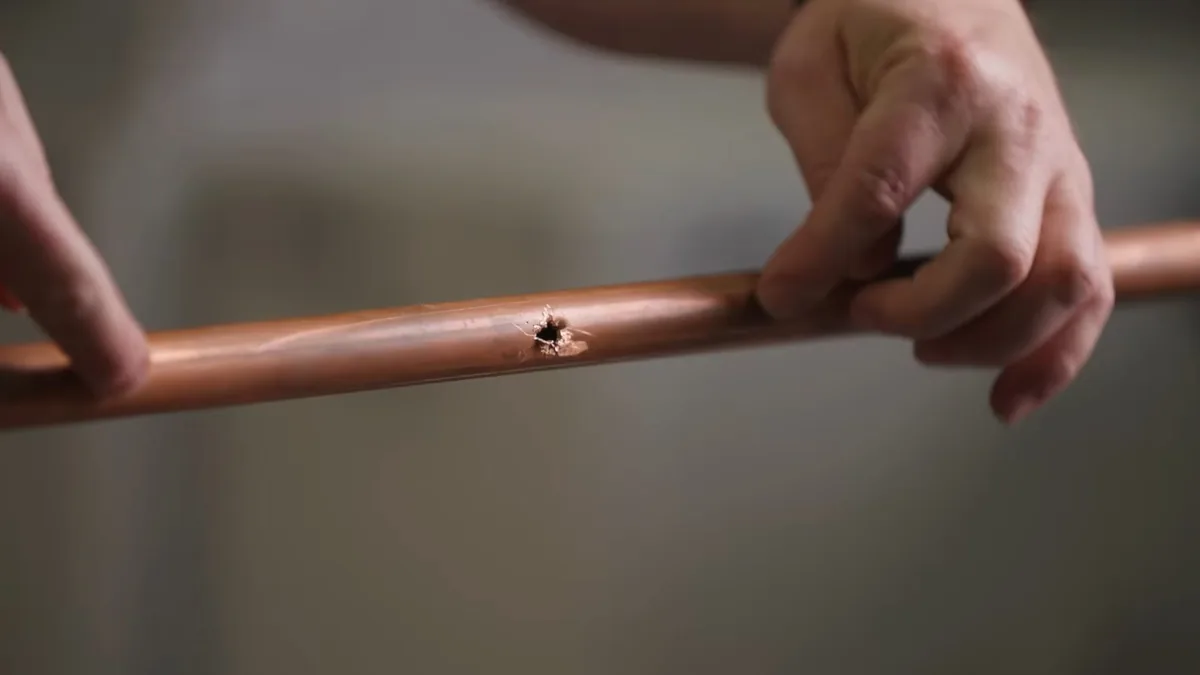
| Pinhole in copper | Fine spray, localised damp, often a stain first | Section replacement, and a look at the rest of the run |
| Failed solder joint | Water at a fitting rather than mid pipe | Remake the joint, check neighbouring ones |
| Nail or screw strike | Leak at a fixing line, often years after the work | Section replacement and reroute around the fixing |
| Outdoor tap line | Damp wall or stain inside the same wall | Open the wall, replace the run and the tap |
| Buried service line | Wet ground, pressure drop, meter moving with the house valve shut | Locate, then repair or replace the run |
If the water is stopped, say so on the call. It changes the priority and it changes what comes out on the van.
Call (833) 571-0120Freeze risk in a city that rarely freezes
The sheet behind this build treats frozen pipes as a standard seasonal topic, which it is across a national portfolio and is not here. Rather than import it or quietly drop it, here is what the record actually supports for Upland.
The climate is Mediterranean: rain arrives in a narrow window from December through March, averaging around 16.7 inches for the year, with February the wettest month at roughly 4.2 inches and August averaging almost nothing. An interior pipe in a heated house is not the exposure here.
What is worth doing is specific and inexpensive. Insulate or cover an exposed hose bib before winter, insulate any run that crosses an unheated garage or an attic, and know where the shutoff is. The city's ground also climbs steadily from south to north, from about 1,175 feet at the southern boundary to about 2,000 feet at the northern one, so a cold night behaves differently at the top of town than at the bottom.
The first hours after a burst: getting the water out
Stopping the flow is not the end of the event. Water moves into cavities, under flooring and along joists within the first hour, and what happens next decides whether this is a repair or a renovation.
The short version: get standing water out, open everything up so air moves, lift what can be lifted off wet floors, and get measurement onto the problem rather than opinion. Materials that feel dry on the surface are frequently not dry inside, and that is the mistake that leads to a smell three weeks later.
The full process, including which materials dry where they are and which do not, belongs on the water damage page. This page stops at the pipe and the water control.
When the same supply run fails twice within a year or two
One corroded hole in a supply line is a repair and should be treated as one. The same run failing again within a year or two is not bad luck; it is the same conditions producing the same result in the next weakest spot.
The things that push a run toward that are known: the age of the pipe, the wall thickness it was made with, water chemistry, and how fast the water moves through it. Upland water is hard, with the City reporting total hardness at 120 parts per million and a range running up to 340, and scale narrows a bore over decades, which raises velocity through what is left.
At that point the arithmetic changes. Paying for repeated emergency call outs, repeated wall openings and repeated making good usually exceeds the cost of repiping the run or the house in one planned project. If you are on your second failure, it is a reasonable thing to ask about before the third.
Commercial risers, shared stacks and buildings with tenants
In a multi tenant building the pipe is the easy part. The difficulty is that a single failure on a riser affects units that have nothing to do with it, the isolation valves are often in spaces nobody present has keys to, and no two sets of drawings agree with each other or with the building.
So the sequence is different. Isolate the smallest section that stops the water, which may mean the riser rather than the unit. Establish who needs to be told and get it done early rather than apologising later. Then repair, with a view to leaving better isolation behind than you found, because the next failure on that stack is a question of when.
Scheduling the planned part out of hours is usually worth more to a business than the labour difference, and it is a conversation to have at the time of the first call rather than at the end of the job.
Shutoffs, section repairs and repeat failures
Worth reading before anything happens rather than during. If something is happening now, skip these and call (833) 571-0120.
I cannot find the shutoff. What do I do?
There are usually two. The house valve is where the supply enters, commonly on an outside wall near a hose bib, in the garage, or in a utility space. The street side is the meter box at the kerb, which needs a meter key, a long handled tool with a slot that fits the valve lug. If you have neither the valve nor the key, the next best thing is the water heater's cold inlet valve for a hot side failure, and the call. Finding the shutoff on a calm afternoon and labelling it is the single most useful ten minutes any homeowner can spend.
Is it safe to be in the room with water coming through a ceiling?
Not if there is any electrical fitting in it, and that includes a ceiling light with water running down the fixture. Water tracks along joists and cable runs and it reaches fittings well away from where it is dripping. If you can get to the breaker panel from a dry position, kill the circuit. If you cannot reach it dry, leave the room, keep people out of it, and say so when you call.
Why do copper pipes fail with a small hole rather than a split?
Because the usual mechanism is corrosion from the inside out at a single point rather than pressure. The result is a pinhole that sprays rather than floods, and the thing worth knowing is that a pinhole is evidence about the whole run, not just that spot. One is a repair. A second on the same pipe inside a year is a signal, and it is covered in its own section below.
Does Upland actually get frozen pipes?
Rarely in the way colder markets mean it, and it is worth being straight about that instead of selling a season that does not exist here. The published climate record for Upland is a Mediterranean pattern, about 16.7 inches of rain a year concentrated between December and March, with an annual average temperature near 63 degrees Fahrenheit. What does happen is localised: an uninsulated run in a garage, an attic or an exterior wall cavity, or an exposed hose bib, during a cold snap. The ground also rises from about 1,175 feet at the south of the city to about 2,000 feet at the north, so a cold night is not the same night everywhere in Upland.
Will the repair be a patch or a replacement?
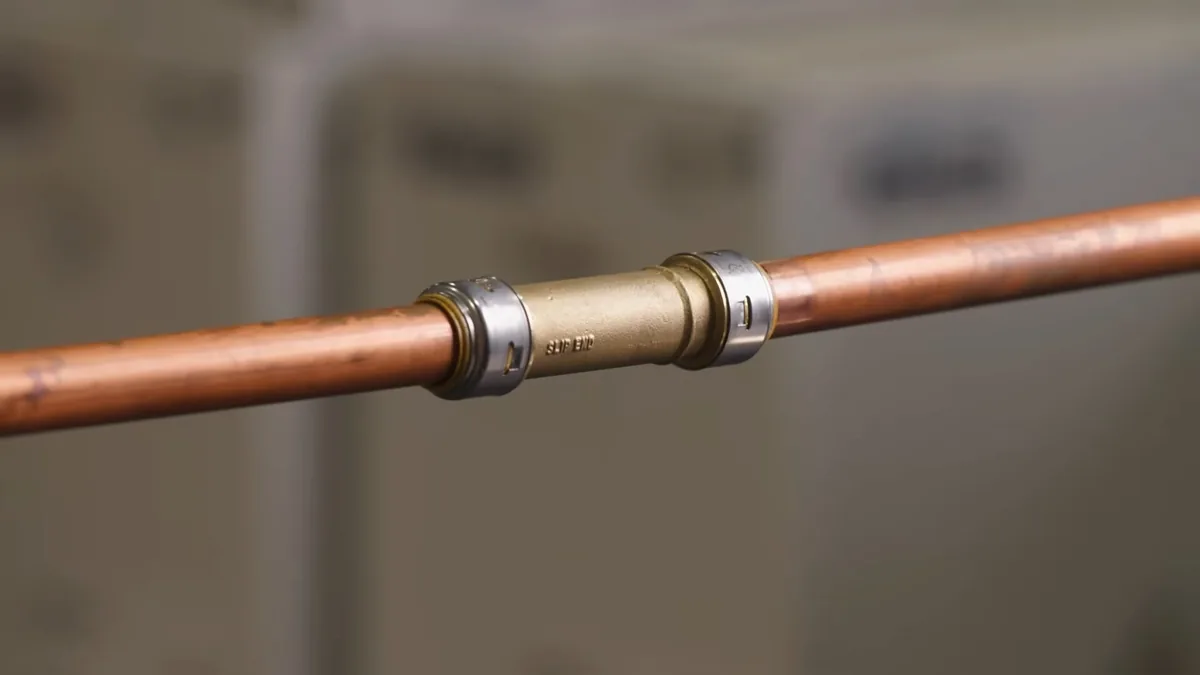
It depends on what the pipe looks like either side of the failure. A clean mechanical failure in sound pipe, a nail strike or a cracked fitting, is a section replacement and ends there. Pipe that is thin, scaled or already showing green at other joints will not hold another repair for long, and the honest answer in that case is to say so and price the run rather than the hole.
Water you cannot stop: get dispatch on the line
Burst & broken pipe repair Upland CA. Tell dispatch what you are seeing and when it started. You get a straight read on urgency and a written price before any work begins.