
Service area · the hardest published water on this list
Emergency Plumber in San Dimas, CA: Heaters, Repairs and the Hardest Water on Our List
San Dimas is the furthest town on this list, about 9.1 miles out, and home to roughly 34,600 people. It is comfortably inside the dispatch area and the whole service list reaches it.
It also has the most consequential published number of the nine. Its supplier reports an average hardness of 205 milligrams per litre, which the report itself converts to about 12 grains a gallon. Upland's own figure is 120 and roughly 7.
At an average near 12 grains a gallon, San Dimas has the hardest published water of any town we cover, Upland included. That one figure explains most of what gets booked here, so read the opening section before you calling dispatch on (833) 571-0120.
San Dimas hardness: 205 mg per litre, with a range of 85 to 307
Golden State Water Company publishes hardness for the San Dimas system as an average of 205 milligrams per litre of calcium carbonate, over a measured range from 85 to 307. Its own conversion puts that at 12 grains a gallon on average, with the range spanning 5.0 to 18.
The range is the supply showing through. Treated groundwater comes out of the Main San Gabriel Basin, local surface water arrives wholesaled from the Covina Valley Water Company, and imported water comes down the Colorado River Aqueduct and the State Water Project. Three inputs in shifting proportions produce a reading that shifts with where in town you sit and which month it is.
Which is why an average is a starting point and not a specification. Equipment sized for 5 grains in a part of town running at 18 will disappoint its owner, and the reverse wastes salt for years.
Source: Golden State Water Company, San Dimas system annual water quality report
The same water, measured three ways
| System | Average | In grains per gallon | Published range |
|---|---|---|---|
| San Dimas | 205 mg/L | about 12 | 85 to 307 mg/L, 5.0 to 18 grains |
| Claremont | 190 mg/L | about 11 | 97 to 330 mg/L, 5.7 to 19 grains |
| Upland, for reference | 120 mg/L | about 7 | not detected to 340 mg/L |
What San Dimas hard water does to heaters and fixtures
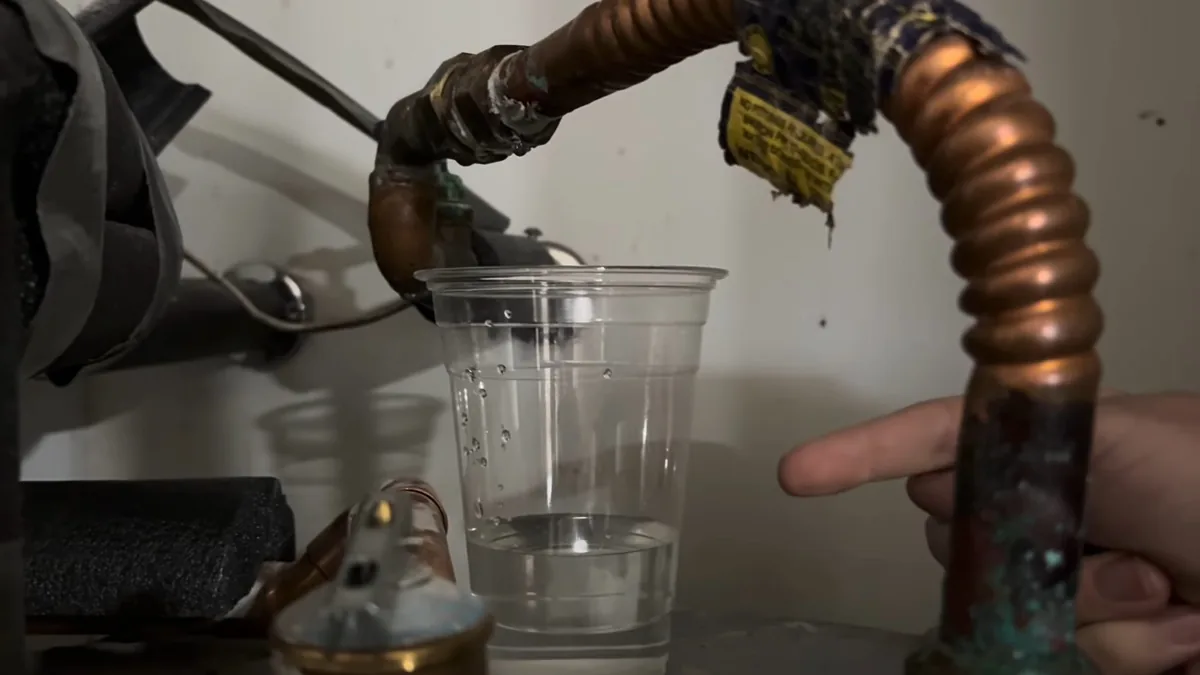
Hardness does not break things on the day. It shortens the gap between the day you stop maintaining something and the day it fails, and at 12 grains that gap is noticeably shorter than in most of the towns on this site.
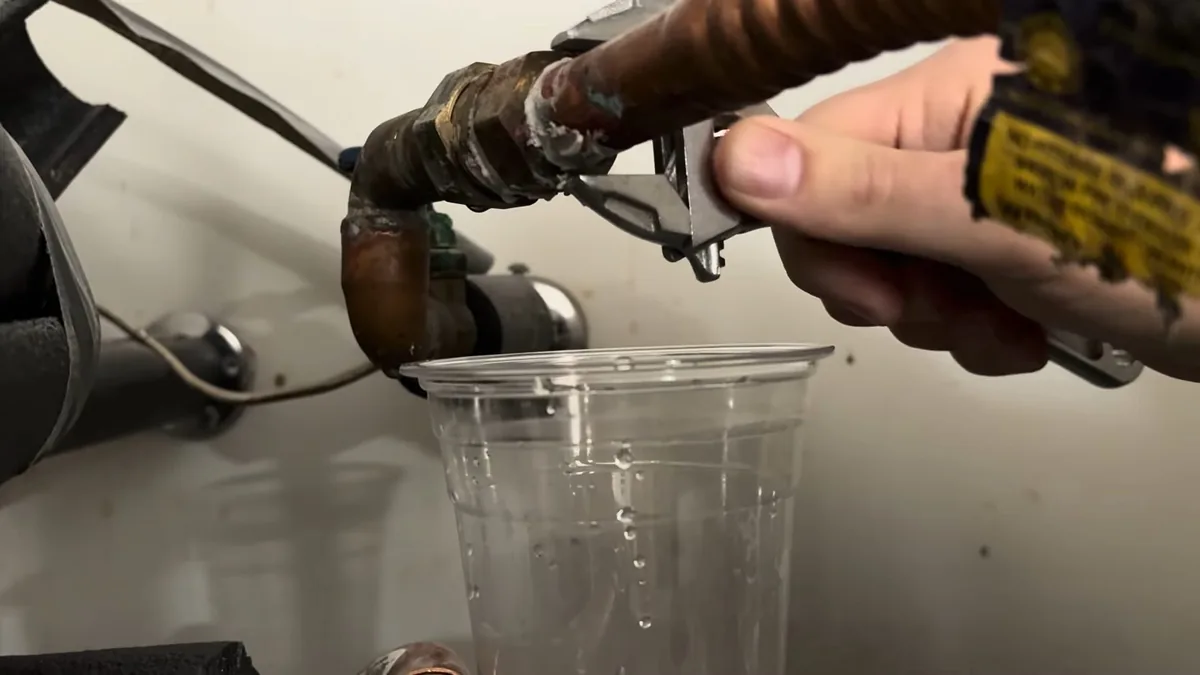
In practice that shows up as a handful of recurring jobs: heaters needing a flush they have never had, tankless units wanting a descale, aerators clogging and going crooked, and mixing cartridges that stiffen before they leak. None of those is dramatic and all of them are cheaper caught early than ignored.
It also changes the repair or replace calculation on an older heater, because a tank that has silted up for a decade has lost usable capacity along with efficiency. The four things that actually decide that call are laid out on the heater repair page.
Worth doing on a San Dimas property, hardness being what it is
- Have the heater flushed yearly, and find out when it last was
- Descale a tankless unit annually, and check that isolation valves were fitted so it can be done at all
- Unscrew and clean aerators when the stream goes crooked rather than replacing the tap
- Get a hardness reading at your own tap before buying any treatment equipment
- Watch for stiffening handles, which arrive before the drip does
- Keep an eye on dishwasher and washing machine performance, which declines quietly rather than suddenly
Tell dispatch when the heater was last flushed. At this hardness, that one date tells us more than the heater's age does.
Call (833) 571-0120San Dimas sits over a different groundwater basin than Upland
Everything on this site about Upland's groundwater describes the Chino, Cucamonga and Six Basins, with the coarse alluvial ground the state bulletin records for the Cucamonga Subbasin. None of that applies here. San Dimas is over the Main San Gabriel Basin, part of the San Gabriel Valley system.
The reason to say so out loud is that local-sounding geology is the easiest thing for a service page to get wrong, and the easiest for a reader to take on trust. A claim about Upland's ground is not a claim about San Dimas's, and nothing on this page borrows one.
Where ground conditions genuinely bear on a job, which is mostly buried lines and anything under a slab, the method is the same wherever you are: locate before excavating. The slab leak repair page covers how.
What San Dimas books most, and why
The full list travels out here. Given a published average of 12 grains, it is no surprise that four of the five busiest are water treatment and hot water jobs.
- Water softeners and filtrationsized on a reading from your tap, not an average
- Water heater repaira silted tank, and what it costs in capacity
- Tankless water heatersannual descaling, and the valves that make it possible
- Faucet and sink repairlimescale in aerators, cartridges that stiffen
- Every service, listedsymptom table first, pages after
Twelve grains, a different basin, and the equipment questions that follow
How hard is San Dimas water?
Harder than anywhere else we cover. Golden State Water Company's annual water quality report for the San Dimas system, the 2026 report covering 2025, gives total hardness as calcium carbonate averaging 205 milligrams per litre across a range of 85 to 307. The report converts that itself: an average of 12 grains per gallon, ranging from 5.0 to 18. For comparison Upland reports 120 milligrams per litre and about 7 grains, and Claremont about 11.
What does 12 grains actually do to a water heater?
It fills the bottom of it. Dissolved mineral comes out of solution as water heats up, so a storage tank collects a sediment bed on the floor that insulates the burner from the water above it. The heater then runs longer for the same result, the lower element or burner area overheats, and you hear it as rumbling or popping. On a tankless unit the mineral coats the exchanger directly, so descaling there is a scheduled job, not an upsell.
Is a softener worth it at this hardness?
At 12 grains the arithmetic is more favourable than almost anywhere nearby, and it is still your call rather than ours to make for you. What a softener changes is scale formation, soap and detergent use, spotting on glass, and the service life you get out of a heater. What it does not change is taste, grit, or deposits already inside existing equipment. Sizing has to use a reading from your own tap, because the published range here runs from 5.0 to 18 grains and those two ends want different machines.
Where does the water come from, since it is not the Upland basins?
A different system entirely. San Dimas draws treated groundwater from the Main San Gabriel Basin, which underlies the San Gabriel Valley, plus local surface water wholesaled by the Covina Valley Water Company, plus imported supply from the Colorado River Aqueduct and the State Water Project. Upland sits over the Chino, Cucamonga and Six Basins instead, so the two towns do not share groundwater at all.
Is nine miles out too far to bother with?
No. It is the farthest of the nine and still routine. The thing worth asking at the scheduling stage is not how fast somebody can arrive but whether the right parts will be on the van, which is why describing the fixture, the make and the symptom carefully pays off more on a longer run than a short one.
Deal with San Dimas hard water properly
Say what is happening and roughly where in San Dimas you are, then ring dispatch on (833) 571-0120. You get a straight read on urgency and a written price before any work begins.